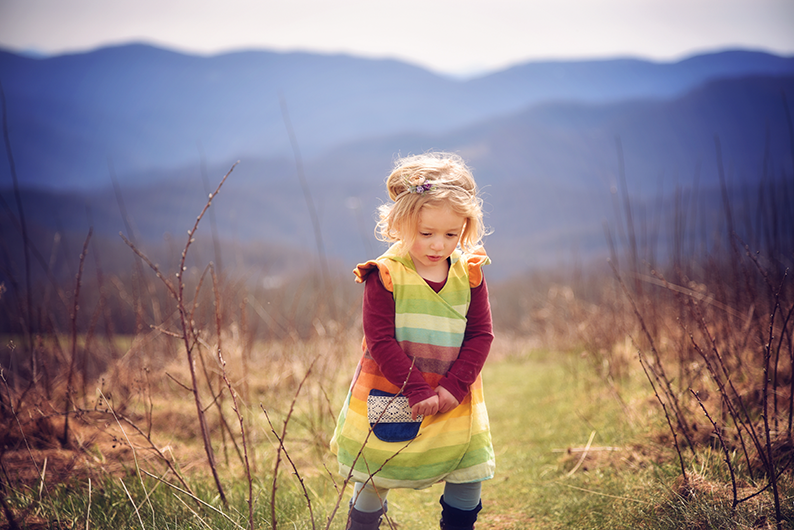
We're so pleased to welcome Twig + Tale Storyteller Catherine Lu to the blog this month. Her topic is a fascinating one, and it actually has a long history: the use of tucks and pleats as both decorative and functional elements in clothing.
Throughout history, tucks and pleats have been used to create adjustable clothing. For example, Victorian children's garments routinely featured growth tucks at the hems and sleeves, pintucked yokes that allow a bodice to be released, and pleated waistbands that could be adjusted.
Over time, mass-production and cheaper fabric have resulted in a more disposable attitude towards clothing, and these features that were once common have largely disappeared. However, for the sewist who puts in the time and effort to create lovingly handmade garments - especially for growing children - we think that bringing back traditional techniques that are both beautiful and extend the life of a garment is a wonderful idea!
Read on to see how Catherine created a beautiful Fable dress that can be extended as her daughter grows.

I have always been a slow sewist. I like to imagine it is the result of a thoughtful, deliberate approach - that each project I make is imbued with careful intention and adorned with intricate details. In truth however, it is more a consequence of too frequent tea breaks, involving chocolate biscuits in the plural, and pauses to leisurely scroll through Youtube or Instagram.
Now, this unhurried pace previously posed no difficulty. Sewing for myself carries no deadlines or urgency. A woollen coat completed in the height of summer can simply be tucked away for next season, awaiting the return of winter's chill.
After the birth of my daughter, however, I found myself facing a dilemma. You see, I want to make adorable children's clothing, now that I have said adorable child to clothe. But, the rate at which she outgrows outfits is alarmingly close to the rate at which I can produce them. Given the number of chocolate biscuits sacrificed each project, I most certainly am not keen on the idea that my hard-sewn efforts will only be worn a handful of times before being relegated to the "too small" pile.
This started my journey into exploring how to "growth proof" outfits. Buttonhole elastic waistbands, generous hems and ample seam allowances - any technique to allow for future expansion and extend a garment's lifespan, without simultaneously overwhelming her toddling frame in the present.
When I first saw April's Storyteller theme of "Embellish", it immediately struck me how many of these practical design elements also serve as a form of embellishment! Decorative horizontal tucks in skirts/pants - often referred to as growth tucks - can be released to lengthen a garment without the need to re-sew a hem. Delicate smocking in baby gowns introduces elasticity and comfort to otherwise non-stretch garments. I thought there was something delightfully satisfying about this union of form and function, details that are both beautiful and purposeful.
Serendipitously, a mere few days after the themes were announced, I came across an inspiring library find: "The Art of Manipulating Fabric" by Collette Wolff. True to its title, the book offered a remarkable array of methods to dart/pleat/tuck or otherwise manipulate fabric. The chapter on tucks, in particular, captured my imagination. I had already been toying with the idea of making a Fable Dress for my daughter incorporating growth tucks, and this gave me the inspiration to elevate them a step further!

A sample of the book's inspirational pages ("The Art of Manipulating Fabric" by Collette Wolff).
After poring over the book at home, I began brainstorming my embellishments. I sketched out a few ideas, and eventually settled on a row of delicate bow tucks for the sleeves, along with a pair of fine pintucks along the bodice to frame the buttons. I had picked out a lovely, light blue cotton remnant as my fabric of choice, and the colour inspired me to go with some undulating tucks along the skirt, reminiscent of rippling waves. To enhance this "ocean-y" theme, I decided to add in the Undersea Garden embroidery to further reinforce the imagery.

Experimenting with different widths, gaps, and designs.
Once I had the overall design down, some experimentation on fabric scraps was required to determine the preferred widths of my tucks and the gaps in between, in proportion to the size of my toddler-sized Fable Dress. For reference, I chose the 18-month size dress for the following measurements. If you would like to try something similar, you may wish to enlarge or shrink the width of the tucks, or change the number of them, to suit the proportions of your project. Here's my best attempt at illustrating the tuck placememnts:


Their placement on the final garment.
For the sleeves, I decided to go with a central bow tuck measuring 1.5cm in width, created by stitching two parallel lines 3cm apart, then pressing the fold through the middle so it lies centred over the seam that was sewn. This was then divided into three sections, and in the centre of each section, the edges of the tuck were pinched together and hands stitched in place, forming the little bows.
Framing this were two narrow pintucks, each 0.5cm wide and spaced 2cm apart from the central tuck, pressed inward towards the centre. This used up a total excess of 5cm of fabric.

My husband (rightly) believes these will become food traps. I maintain they are totally worth it!
The skirt incorporated four rows of 1cm wide tucks, spaced 1.5cm apart. They were also divided evenly in each segment, stitched in alternating direction. This used up 8cm of fabric. Note that although I marked the lines of the tucks first, I assembled the skirt panels before sewing the tucks, to ensure that future adjustments would not disturb the side seams when the tucks are eventually released.
I added the Undersea Garden embroidery to the front edge of the skirt (along with the back bodice). I chose to embroider the skirt prior to sewing the tucks, so as to allow the design to flow uninterrupted once the tucks are released. This did mean the design is distorted once the tucks are in place, but I like to think it mimics how you'd see it shifting beneath the surface of water!

Totally convincing of how seaweed looks under waves, right?
I marked and sewed both the sleeve and skirt tucks directly onto the original pattern pieces unaltered (which I otherwise would have needed to shorten).
The pintucks in the bodice, however, required an adjustment of the bodice piece - I extended the area adjacent to the button placements by 2cm (for the 18 month size this was 4cm away from the edge of the bodice). From there, I sewed two vertical tucks 0.5cm in width, 1cm apart.

These I originally sewed purely as a decorative element. However, I ended up putting a pleat of 2cm in the bodice lining at the same area, just in case I ever wanted to undo the tucks in the future (which would give me 4cms of extra width in the bodice). I am actually not sure about the feasibility of this plan, as I did not add anything in the back bodice to balance this with, but I thought there would be no harm in putting in in just in case.
For the final touch, I added two pieces of lace onto the bodice - they reminded me of seashells, and if I was ever to remove the pintucks, they would serve as a remaining decorative element.

Finished off with some lovely blue buttons - a source of functional embellishment in itself!
I was very pleased at the end outcome of my dress. For me, one of the greatest joys of sewing is being able to create something unique through my choice of pattern, fabric and embellishment. It has brought me even greater delight in knowing that these beautiful elements also serve a purpose - these lovely waves and bows will help extend the life of this dress.

Equipped for many more duck feeding adventures ahead.
Of course, these tucks are only the tip of the iceberg when it comes to functional embellishments. Other beautiful and useful design elements that came to mind while working on this project included:
- Decorative pockets - I love a cute patch pocket. T+T in particular have two pocket pattern collections (Kea and Tui) that feature some lovely, unique designs that I hope to try out one day.
- Statement buttons, zippers, or other decorative fasteners.
- Adding ruffles to areas of garments where extended length is required.
- Using trims or patches to cover up fading/worn areas on garments, or using visible mending/sashiko, which highlights the mending as a decorative element.
I would be delighted to see how everyone else interprets this idea of functional embellishment, whether ones you have used from the list above, or ones that I haven't thought of. The discussion around embellishments has been going on all month in the T+T Treehouse community, and I would love to see and be inspired by any techniques or creations that you'd like to share there!